The world of movies just had a giant earthquake! Netflix, the place where we watch Stranger Things, and Warner Bros., the home of Harry Potter and Batman, are joining forces. While this sounds like a dream for people who love to binge-watch at home, it might be a nightmare for your local cinema hall.
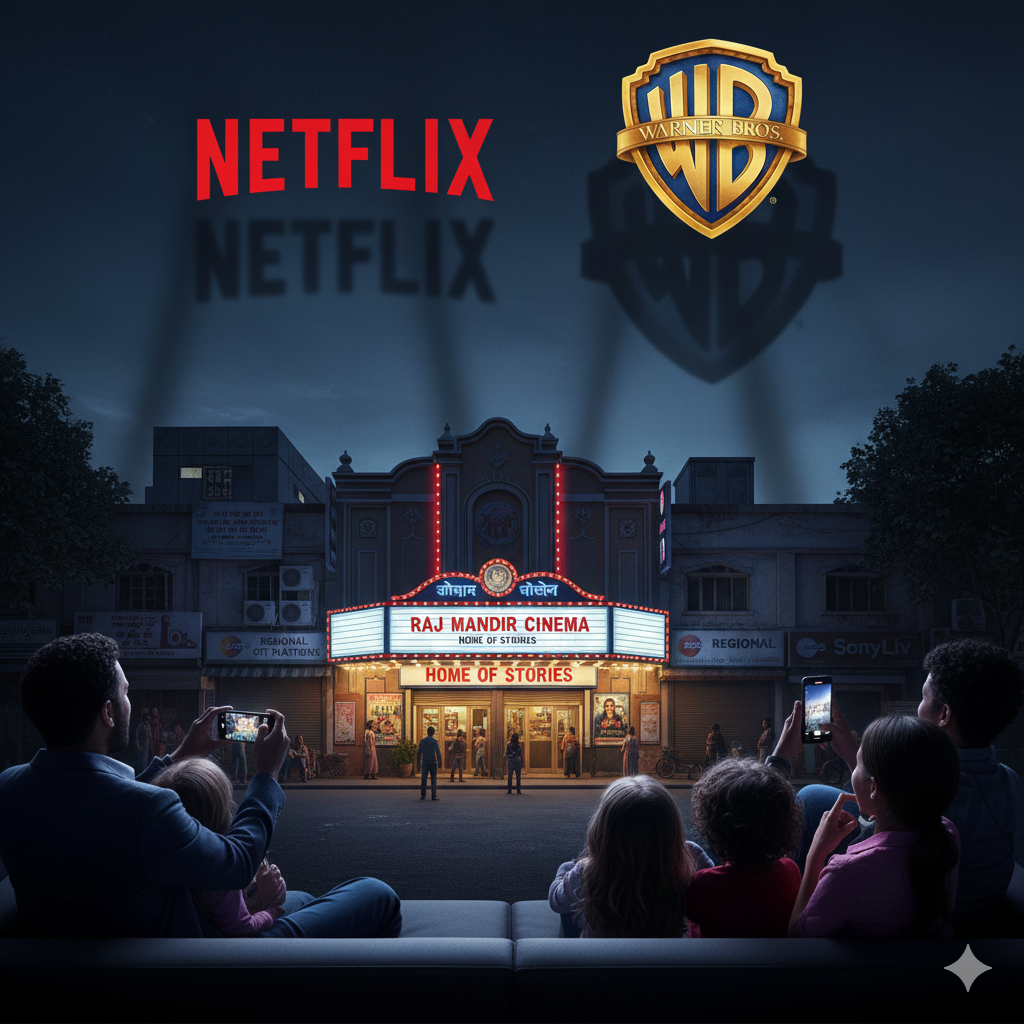
In our deep-dive guide, Netflix-Warner Bros Merger Could Spell Doom for Indian Theatres, Regional OTT Platforms, we are going to look at why the Multiplex Association of India (MAI) is so worried. We will find out if Hollywood movies like Superman will stop coming to theaters and go straight to your phone instead.
We will also see how big Indian apps like Zee5 and SonyLIV might have to fight harder to survive against this new “Global Super-Streamer.” From the “death of the big screen” to the struggle of local stories, we are going to explain everything in a way that is easy to understand. So, grab your popcorn (even if it’s from your own kitchen) and let’s see what the future holds for Indian entertainment!
1. The Global Earthquake: Netflix and Warner Bros Join Forces
Imagine if the two biggest toy stores in the world became one. That is exactly what is happening in Hollywood. Netflix has made a massive $83 billion deal to buy Warner Bros Discovery’s studios and the famous HBO brand.
A New King of Streaming
With this merger, Netflix will now own almost every famous story you can think of—from Game of Thrones to the DC Universe. Experts say this combined giant will control over 33% of all streaming hours in the US! This makes them even bigger than YouTube.
- Long-tail Keyword: Impact of Netflix-Warner Bros merger on global film distribution 2026.
Why the World is Watching
This isn’t just about America. Because Netflix is a “Global Platform,” what they decide in their office in California changes what we see in Mumbai, Delhi, or Bangalore. If they decide that the next big movie is “Streaming-Only,” then cinema halls across India will have empty seats.
2. Why Indian Multiplexes are Sounding the Alarm
If you love going to the movies to see big Hollywood action, you might have noticed that many of those movies come from Warner Bros. Now, the owners of those movies have a different plan.
The “Direct-to-OTT” Fear
The Multiplex Association of India (MAI) is very scared. Historically, Netflix has preferred to release its movies directly on its app, not in theaters. MAI President Kamal Gianchandani warns that if Warner Bros. movies follow this “Netflix model,” theaters will lose high-quality content.
- Data Point: Hollywood movies contribute 15-20% of revenue for big chains like PVR-INOX. Losing even a small part of that could hurt them badly.
Shortening the “Theatrical Window”
Usually, a movie stays in theaters for 6 to 8 weeks before it comes to your phone. Netflix often wants to put movies on their app after just a few days—or even on the same day! This takes away the reason for people to buy expensive theater tickets.
3. The Struggle of Regional OTT Platforms
It isn’t just the theaters that are worried. Local Indian apps like Zee5, SonyLIV, and Sun NXT are facing a “David vs. Goliath” battle.
The Content Monopoly
If Netflix becomes the only place to watch Harry Potter and DC heroes, people will stop paying for other apps. In a price-sensitive market like India, most families only want to pay for one or two subscriptions. If Netflix has “everything,” smaller regional platforms might lose their subscribers.
- LSI Term: Competition between global OTT giants and Indian local apps.
The Pressure to Spend More
To keep up with a giant like Netflix, Indian platforms will have to spend much more money to make better shows. But because Netflix is so big, it can afford to spend billions. This could “squeeze” regional players into a corner where they can’t afford to compete anymore.
4. The “JioStar” Factor: India’s Internal Rivalry
While Netflix is growing, it has to face a local champion: the newly merged JioStar (Reliance and Disney+ Hotstar).
Sports vs. Movies
The battle for Indian screens is being split into two. JioStar currently dominates live sports (like the IPL), while Netflix-Warner Bros wants to dominate movies and “prestige” TV.
- The Squeeze: If a family pays for JioStar for cricket and Netflix for movies, there is no money left for apps that only show regional movies. This is why experts say the merger is “negative” for broadcasters like Zee and Sun TV.
Consolidation is the New Trend
We are seeing fewer, but much bigger, companies. Just like the global Netflix-Warner deal, India is seeing its own local mergers. This makes it very hard for a new, small app to ever start or succeed.
5. Visualizing the Entertainment Crisis
Infographic Concept 1: The “Theatre Revenue” Leak
Imagine a bucket labeled “Multiplex Earnings.” Hollywood franchises are a big part of the water in that bucket. A pipe labeled “Netflix Direct-to-App” is shown draining that water away.
- Alt Text: Netflix-Warner Bros Merger Could Spell Doom for Indian Theatres revenue leak diagram.
Infographic Concept 2: The Subscription Pie
A pie chart showing how most Indian households only subscribe to 2 platforms. The biggest slices are taken by Netflix and JioStar, leaving only tiny “crumbs” for regional players.
- Alt Text: Subscription fragmentation and dominance in India 2026.
6. Cultural Impact: Will Local Stories Disappear?
When a giant global company controls what we watch, they often want “one size fits all” stories that work in every country.
The Loss of “Locally Rooted” Tales
Critics fear that if Netflix dominates the creative market, Indian filmmakers will be forced to make stories that look like “Global Formats” (like Money Heist or Elite) instead of stories that reflect real Indian culture and regional languages.
Fewer Risks for Small Artists
A “monopoly” means there are fewer people to buy your movie. If Netflix is the only big buyer, they can say “No” to risky or experimental stories. This could lead to what some filmmakers call a “slow-motion creative disaster”—where every movie starts to look and feel the same.
- Long-tail Keyword: Monopoly in content distribution impact on Indian creators.
Quick Takeaways
- The Merger: Netflix is buying Warner Bros. studios and HBO for $83 billion.
- Theater Risk: Indian theaters could lose 15-20% of their revenue if Hollywood movies skip the big screen.
- Shorter Windows: Netflix might release movies on their app much faster, hurting ticket sales.
- Regional Platforms: Small Indian apps like Zee5 and Sun TV face a massive threat to their subscriber base.
- Monopoly Concerns: Fewer companies mean less choice for viewers and fewer opportunities for experimental filmmakers.
- The Duopoly: The future might be a battle between just two giants: Netflix (Movies) and JioStar (Sports).
Conclusion: A Turning Point for Indian Cinema
We hope you enjoyed our look at Netflix-Warner Bros Merger Could Spell Doom for Indian Theatres, Regional OTT Platforms. As we have seen, this isn’t just a business deal; it is a change in how we live our lives. The magic of the big screen—the loud speakers, the giant dark room, and the shared gasps—is under threat by the convenience of the small screen.
While Netflix promises to keep theaters in mind, their history tells a different story. For India, a country that loves its cinema halls like a second home, this merger is a serious wake-up call. We might see multiplexes having to change their strategy, perhaps by showing more sports or focusing even more on South Indian and regional mega-hits.
One thing is certain: the “Streaming Wars” have entered a new, much more intense phase. Whether this leads to better movies for us or the death of our favorite theater remains to be seen. But for now, the industry is on edge, waiting to see if this “global blockbuster” deal has a happy ending for India.
Do you think you would stop going to theaters if you could watch Batman on Netflix the same day? Or is the theater experience too special to lose? Let us know in the comments and share this story with your movie-loving family!
Frequently Asked Questions (FAQs)
1. Will ‘Harry Potter’ and ‘Game of Thrones’ move to Netflix in India? Yes! If the deal is finalized, Netflix will likely become the exclusive home for all HBO and Warner Bros. content, which was previously licensed to platforms like JioCinema.
2. Why are Indian multiplexes so worried about a global deal? Because Hollywood franchises like Superman or Dune are big money-makers for Indian theaters. If these movies go straight to Netflix, theaters lose a lot of “High-Yield” revenue.
3. Will regional apps like Sun NXT or Hoichoi survive? They might need to find “niche” audiences or partner with giants like Amazon to survive. It will be much harder for them to compete alone against the Netflix-Warner catalogue.
4. When will this merger actually happen? It is expected to take 12 to 18 months for the government to approve the deal, so we might see the full impact starting in late 2026 or early 2027.
5. Does this mean fewer Indian movies will be made? Not necessarily, but there might be more pressure to make movies that look “International.” This could make it harder for small, purely local stories to get funded.
We Value Your Spidey-Senses!
Did this article help you see the future of your Friday nights? Please leave a comment below and tell us which platform you use the most! Don’t forget to share this on social media to start a conversation about our beloved cinema halls!
References
- The Wire: Netflix-Warner Bros Merger Could Spell Doom for Indian Theatres
- LiveLaw: How Netflix–Warner Bros Merger Could Reshape India’s OTT Market
- Forbes India: What the Netflix–Warner Bros deal signals for India’s entertainment industry
- Exchange4Media: Why India’s content industry is watching Warner Bros deal closely
- The New Indian Express: Netflix’s Warner Bros. deal: Indian multiplexes flag existential concerns