Have you ever heard a story that sounded super exciting but turned out to be just a big “make-believe” game? Imagine if someone told you that the moon was actually made of cheese. It sounds funny, right? But if they kept saying it over and over and tried to change all the science books, it wouldn’t be very nice.
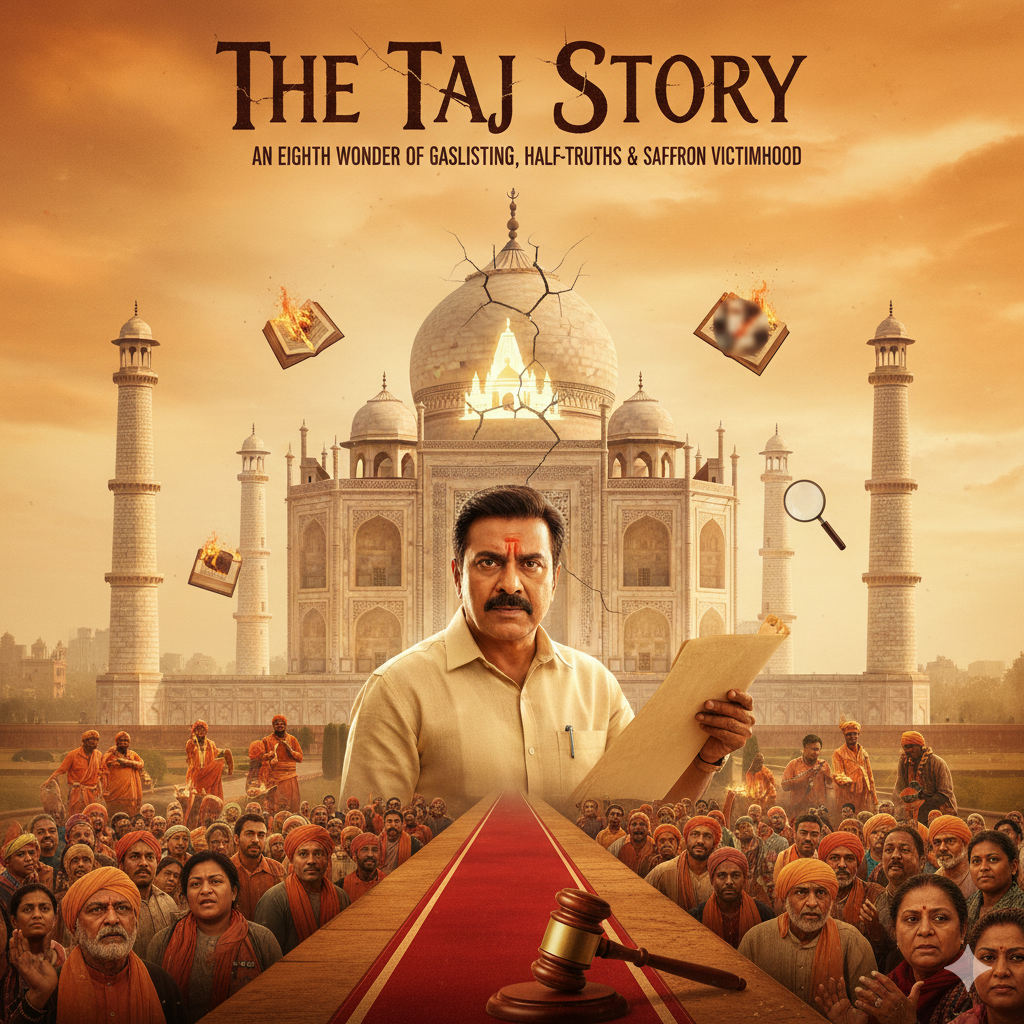
That is what is happening with a movie called The Taj Story. The Taj Mahal is a beautiful white building in India that people from all over the world come to see. Most people know it was built by an Emperor named Shah Jahan for his wife because he loved her very much. But this new movie tries to say that isn’t true!
In our guide, The Taj Story is an Eighth Wonder of Gaslighting, Half-Truths and Saffron Victimhood, we are going to look at why this movie is like a big, confusing puzzle. We will talk about “gaslighting” (which is a fancy word for trying to make people doubt what is true), “half-truths” (which are stories that only tell a tiny bit of the truth), and why some people feel like “victims” when they don’t need to. Let’s learn how to tell a real history story from a pretend one!
1. What is ‘The Taj Story’ Movie?
Every movie tells a story, but this one is trying to tell a very different version of history.
A State-Approved Tour Guide
The movie stars a famous actor named Paresh Rawal. He plays a man named Vishnu Das who has been a tour guide at the Taj Mahal for 25 years. In the movie, he suddenly decides that everything he has been saying for 25 years is a lie. He claims that the Taj Mahal wasn’t built by a Mughal Emperor, but was actually an old temple for the god Shiva called Tejo Mahalaya.
Making Up a New Past
The movie uses a “courtroom drama” style, which means they act like they are in a big room with a judge. They try to “put the Taj Mahal on trial.” But the problem is, the ideas they use in the movie were already checked by real scientists and historians many years ago, and they were found to be incorrect. This is what we call pseudo-history—it looks like history, but it’s actually made up.
- Long-tail Keyword: The Taj Story movie historical accuracy review.
2. Understanding “Gaslighting” in History
“Gaslighting” is a big word, but it’s easy to understand if you think about a lightbulb.
Flickering the Lights
Imagine someone turns the lights off and tells you, “The lights are still on, you just can’t see them!” After a while, you might start to wonder if your eyes are broken. That is gaslighting. In The Taj Story, the movie tries to make people doubt real history by pointing at small things and saying, “See? This proves everything you know is wrong!”
Poking Holes in the Truth
The movie doesn’t have real proof, so it just tries to make people feel confused. It uses half-truths to plant a seed of doubt. For example, it might say “There are sealed rooms in the Taj Mahal!” That is true—many old buildings have rooms that are closed to keep them safe. But then it adds a lie: “Those rooms have secret idols in them!” There is no proof for that, but the movie wants you to believe there is.
- LSI Term: Historical revisionism and cognitive dissonance.
3. What are Half-Truths?
A half-truth is like telling your mom, “I ate all my vegetables,” when you actually only ate one pea and hid the rest in your napkin.
Choosing Only the “Easy” Facts
In the movie The Taj Story, they take real things and twist them. They might show a symbol that looks like a flower and say, “This is a Hindu symbol!” While some flowers are used in many religions, the Taj Mahal’s flowers were designed in a special Indo-Islamic style.
Ignoring the Big Picture
To make their story work, the makers of the movie have to ignore thousands of pages of old books and letters written by the people who actually built the Taj. They ignore the Archaeological Survey of India (ASI), which are the experts who take care of the building. By only telling half the story, the movie creates a “fake truth” that can be very dangerous.
- Long-tail Keyword: Tejo Mahalaya theory debunked by ASI.
4. The Feeling of “Saffron Victimhood”
Sometimes, people feel like they are being treated unfairly even when they are doing great.
Feeling Like the “Underdog”
“Saffron” is a bright orange color that many people in India use to represent their culture. In the movie, the characters act like they are “victims” because they think the “real” history of India was hidden from them by “leftist” teachers. This is called Saffron Victimhood. It’s a way of feeling sad or angry about the past to make people want to change the present.
Crusaders for a Fake Past
The movie portrays the main character as a “crusader”—a hero fighting a big, scary group of people who want to hide the truth. But in real life, historians just want to look at the facts. By acting like a victim, the movie tries to make people feel emotional instead of thinking clearly. This is a common theme in propaganda films that try to change how we feel about our neighbors.
- LSI Term: Majoritarian identity and historical grievances.
5. Visualizing the “History vs. Fiction” Battle
Infographic Concept 1: The Fact-Checker Scale
Imagine a big balance scale.
- On the Left (Real History): Books from 1600, letters from architects, marble from Rajasthan, and expert reports. (This side is very heavy!)
- On the Right (The Movie Story): One man’s theory from the 1960s, viral internet rumors, and “what-if” guesses. (This side is very light).
- Alt Text: The Taj Story is an Eighth Wonder of Gaslighting, Half-Truths and Saffron Victimhood Fact Check.
Infographic Concept 2: The “Seed of Doubt” Flower
A drawing of a beautiful flower (The Taj). Beneath it, someone is planting a small, prickly weed labeled “Inane Holes.” This shows how small lies try to grow and cover up a beautiful truth.
- Alt Text: How pseudo-history tries to hide historical facts about the Taj Mahal.
6. Why Does This Matter? The Danger of Fake History
You might think, “It’s just a movie, who cares?” But stories have power.
Protecting Our Shared Home
India is like a big house where many families have lived for a long time. The Taj Mahal is a part of that house that everyone should be proud of. When a movie like The Taj Story tries to take that away from one group and give it to another, it makes the people in the house start to argue.
The Cost of Confusion
When people stop believing in real facts, they can be easily tricked. If we let movies change the past, we won’t know how to build a good future. It’s important to listen to rigorous historical research instead of “WhatsApp forwards” that become movies. We must protect the “shared ground” that helps a plural society like India stay peaceful.
- Long-tail Keyword: Impact of propaganda movies on communal harmony in India.
7. Learning to be a “Truth-Seeker”
A real truth-seeker is someone who is humble and listens to the evidence, even if it’s not what they wanted to hear.
How to Spot a Fake Story
- Check the Evidence: Does the movie show real books or just act like they exist?
- Look at the Experts: Do real scientists agree, or is the movie fighting against them?
- Watch the Emotions: Is the movie trying to make you feel angry or like a victim?
The Real Taj Story
The real story of the Taj Mahal is about thousands of workers—Hindus, Muslims, Persians, and Italians—who worked together for 22 years to build something so beautiful that the whole world loves it. That is a much better story than the one in the movie! It shows what people can do when they work together instead of fighting over the past.
- LSI Term: Indo-Islamic architecture and syncretic culture.
Quick Takeaways
- The Movie: The Taj Story claims the Taj Mahal was a Shiva temple, an idea that has been officially rejected by courts and historians.
- Gaslighting: The film tries to make viewers doubt proven facts by using “unsubstantiated history.”
- Paresh Rawal: Despite being a great actor, his character in this film is a “post-truth seeker” who ignores real evidence.
- Half-Truths: The movie cherry-picks small details to create a “fiction” that feels real to those who don’t know the facts.
- Saffron Victimhood: The narrative portrays a specific group as “victims” of a historical conspiracy to stir up emotions.
- The Goal: Critics say the movie’s goal isn’t to find the truth, but to “plant a seed of doubt” about India’s plural past.
Conclusion: Honesty is the Real Wonder
We have explored The Taj Story is an Eighth Wonder of Gaslighting, Half-Truths and Saffron Victimhood, and what we found is that real history is always more interesting than pretend stories. The Taj Mahal stands tall as a symbol of love and teamwork. It doesn’t need to be “put on trial” because its beauty and its history are already clear for all to see.
When we watch movies, it’s fun to go on an adventure, but we have to be careful when the movie tries to tell us that “up is down” or “black is white.” By staying curious and listening to real experts, we can make sure that fake stories don’t win.
The Taj Mahal is truly a “Wonder of the World,” and the best way to honor it is by telling the true story of how it was made. Let’s keep our history books full of facts and our hearts full of kindness for everyone who helped build our country.
Have you seen the Taj Mahal in person, or did you see it in a movie? What is your favorite thing about history? Let us know in the comments and share this article to help your friends become real truth-seekers!
Frequently Asked Questions (FAQs)
1. Is ‘The Taj Story’ based on a true story? No. While the movie uses real locations, its main idea—that the Taj Mahal was a Hindu temple—is considered fiction and has been debunked by the Archaeological Survey of India (ASI).
2. Who came up with the “Tejo Mahalaya” idea? The theory was popularized by a writer named P.N. Oak in the 1960s. However, historians and the Supreme Court of India have rejected his claims because they have no real evidence.
3. Why do people call the movie “gaslighting”? Because the movie tries to make the audience feel like the history they learned in school is a lie, even though that history is backed up by thousands of real documents and physical evidence.
4. What does “Saffron Victimhood” mean? It refers to a feeling of being a “victim” based on religious or cultural identity. The movie uses this feeling to make people feel like their heritage was “plundered” or hidden from them.
5. How do we know the Taj Mahal was built by Shah Jahan? We have many proofs! There are royal chronicles from that time, letters from the architects, bills for the marble, and even inscriptions on the walls that name the calligraphers.
A Note for Our Readers
Did this look into The Taj Story help you understand the difference between history and fiction? Please leave a comment below! We love to hear what you think. Don’t forget to share this post to help spread the truth!
References
- The Wire: The Taj Story is an Eighth Wonder of Gaslighting, Half-Truths and Saffron Victimhood
- Times of India: Claims to Taj Mahal as a Temple Based on Nothing at All
- Sabrang India: The Taj Story and Resurgence of a Myth – Ideological Engineering
- KashmirPEN: Debunking the Urban Myth of the Taj Mahal and Chopped Hands
- ENewsroom: The Danger of Pseudo-History in The Taj Story Movie Review